
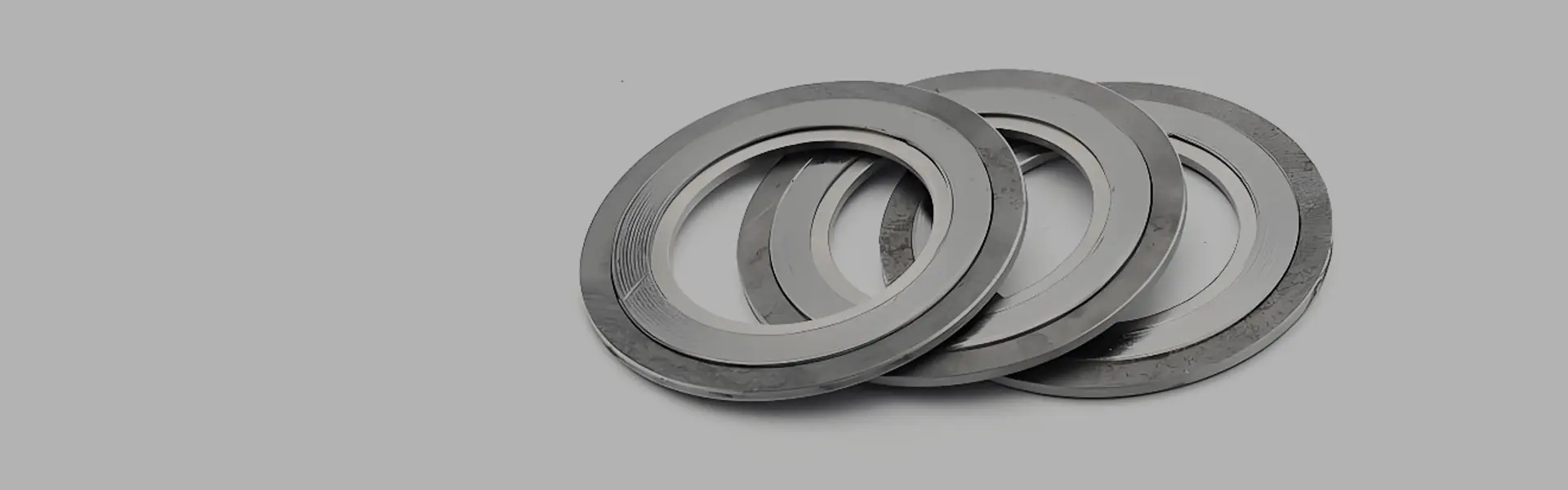
Imagine walking through the auxiliary building of a nuclear power plant during an outage. Every flange joint you pass holds back high-temperature, high-pressure, or radioactive fluids. A single leak could trigger safety systems, halt operations, or worse. The reliability of each connection often comes down to a component few people see: the nuclear spiral wound gasket. But what are the typical sizes and dimensions of nuclear spiral wound gaskets? If you’re sourcing these critical seals, getting the answer right isn’t just a matter of fit—it’s a matter of plant safety, regulatory compliance, and lifecycle cost. These gaskets follow stringent dimensional frameworks such as ASME B16.20 and custom nuclear specifications, covering NPS from ½ inch all the way to 60 inches, with pressure classes from 150 to 2500. Yet real-world procurement rarely matches a textbook table. Flanges can be corroded, retrofitted, or built to non-standard bores. At Ningbo Kaxite Sealing Materials Co., Ltd., we’ve spent years bridging the gap between standard dimensions and field realities, delivering spiral wound gaskets that fit precisely under the most demanding nuclear service conditions. In this guide, I’ll break down everything you need to know about the sizes, the hidden pain points in procurement, and how to specify a gasket that eliminates leaks before they start.

Pain Point: A procurement engineer at a European nuclear plant places an order for “DN150 PN160 spiral wound gaskets.” The supplier delivers gaskets with inner diameters matching the metric bore, but the plant’s older flanges follow a slightly different DIN standard. The gaskets fit loosely on the ring groove, and during hydrotest, a small seep appears. The order is rejected, and a month of downtime looms. This scene repeats itself because nuclear flanges often deviate from purely modern dimensional references.
Solution: Successful specification starts with understanding the dimensional backbone. Nuclear Spiral Wound Gasket dimensions are primarily defined by the facing, ring type, and nominal pipe size (NPS). The governing standard, ASME B16.20, provides tables for sealing element inner and outer diameters, outer ring dimensions, and thickness. For NPS 1 through NPS 24 (and larger), you’ll typically see gaskets designed for flat face (FF) or raised face (RF) flanges with an inner ring, winding, and outer ring. Compressible thicknesses usually range from 4.5 mm to 7.2 mm, with winding widths scaling to pressure class. However, nuclear applications often layer additional requirements—Class 1500 and 2500 gaskets, compact flanges with limited space, or anti-blowout inner rings all demand tailored dimensions. At Ningbo Kaxite Sealing Materials Co., Ltd., we maintain an exhaustive database of nuclear utility specs, so we cross-check your flange type, facing finish, and service media before cutting any gasket.
To give you a practical starting point, here is a table of typical nuclear spiral wound gasket dimensions for ASME B16.20 Class 150 4.5 mm thickness:
| NPS | Sealing Element ID (mm) | Sealing Element OD (mm) | Outer Ring OD (mm) |
| 1/2 | 15.0 | 25.4 | 47.8 |
| 2 | 47.8 | 69.9 | 104.9 |
| 6 | 147.3 | 183.5 | 222.3 |
| 12 | 298.5 | 358.0 | 409.6 |
| 24 | 585.0 | 660.4 | 711.2 |
These values serve as a baseline, but remember that nuclear projects often use thicker windings or modified IDs to protect against graphite erosion in high-flow steam lines.
Pain Point: Your approved vendor list only includes a generic supplier using table values. You need a replacement gasket for a reactor coolant pump flange that was machined after previous corrective maintenance—its actual groove diameter is 1.5 mm larger than the ASME table. The catalog gasket will leave a dead space prone to crevice corrosion and radiation holdup. Delays ripple through the work package as you search for a vendor willing to accept a non-standard order with full traceability.
Solution: This is where partnership with a specialist like Ningbo Kaxite Sealing Materials Co., Ltd. changes the game. Our engineering team routinely reverse-engineers obsolete or modified flanges directly from on-site measurements. We maintain a library of historical nuclear plant flange databases, so when you tell us “St. Lucie Unit 2 RCP suction flange, post-2019 repair,” we can reference past projects and propose a verified dimension set. We also apply a factor of safety to inner ring dimensions based on thermal cycling data, ensuring that the gasket never encroaches into the bore during heat-up transients. This approach has eliminated rework for dozens of nuclear outages across Asia and Europe.
Here is a comparison of how custom dimensioning avoids common failure modes:
| Failure Mode | Root Dimension Cause | Kaxite Custom Fix |
| Inner ring buckling | ID too small for thermal expansion | ID calculated with 0.5% margin above max expected pipe bore |
| Blowout at outer ring | Outer ring OD under tolerance for worn flange recess | Outer ring OD precision-machined to flange groove +0.2/-0.0 mm |
| Creep relaxation | Winding width insufficient for bolt load distribution | Wider winding section engineered per bolt circle diameter |
These adjustments often prevent multi-million-dollar outage extensions and make the difference between a gasket that barely passes a hydrotest and one that lasts a full fuel cycle.
Pain Point: A French nuclear operator needs spiral wound gaskets for their boric acid lines. The standard dimensions work, but the aggressive media demands a specific nickel-chrome winding and a graphite filler with leachable chlorides below 50 ppm. Most suppliers stock generic 304L windings; delivering both the exact material and the exact NPS 8 Class 600 dimensions with full PMI traceability becomes a six-month lead-time headache.
Solution: Ningbo Kaxite Sealing Materials Co., Ltd. seamlessly integrates material integrity with dimensional precision. We stock and machine Inconel 600, 625, and Monel winding strips in widths down to the millimeter for nuclear service, alongside purified graphite and PTFE fillers. When you ask “what are the typical sizes and dimensions of nuclear spiral wound gaskets for alloy C-276 windings in class 900 flanges?” the answer isn’t just a table number—it’s a spec sheet that includes post-forming thickness mapping and pneumatic seat testing. Our short, transparent supply chain reduces lead times for custom alloys to as little as 4 weeks, because we draw from pre-qualified melts and keep common nuclear dimensions in semi-finished inventory.
Below is a material-to-dimension capability matrix for our nuclear program:
| Winding Material | Filler | Typical NPS Range | Dimensional Special Feature |
| Inconel 600 | Purified Graphite (Cl- < 30 ppm) | 1/2 – 36 | Reduced ID for thin-walled pipes |
| Inconel 625 | Expanded PTFE | 1/2 – 48 | Integral outer ring with NACE MR0175 hardness |
| 304L/316L dual certified | Mica-graphite for fire-safe | 1/2 – 60 | Thick windings for Class 2500 |
Having one partner that controls both the material lot and the CNC winding profile eliminates the finger-pointing that often occurs when dimensions drift due to inconsistent strip properties.
A: For standard ASME B16.20 Class 1500 NPS 10, the sealing element ID is approximately 258.8 mm, OD around 302.3 mm, and the outer ring OD near 372.4 mm, with a 4.5 mm thickness. However, nuclear applications in confined areas often require a reduced outer ring OD to clear interference. We have supplied custom gaskets with an outer ring turned down to 360.0 mm, accompanied by full finite element analysis showing no compromise on seat load. At Ningbo Kaxite Sealing Materials Co., Ltd., we recommend always sending us a flange sketch or photo—dimensions on paper are a starting point, not a prison.
A: In such cases, there is no “typical” table. We start with the flange dimensions you measure—inner bore, facing outer diameter, bolt circle—and design a gasket that mimics the relaxed seating stress of the original, often a thicker winding of 6.4 mm to accommodate flange misalignment. For a recent BWR retrofit, we manufactured a gasket with an ID of 102.0 mm, OD of 148.5 mm, and outer ring OD of 190.0 mm, far from any standard NPS. The key is to provide a specimen or detailed drawing. We then produce a First Article with a dimensional inspection report (CMM data) before serial production, ensuring zero surprises during installation.
Pain Point: You receive gaskets for a reactor building closed-loop cooling system that are marked as NPS 4 Class 300. On the caliper, however, ten gaskets show an outer ring OD tolerance spread of ±0.8 mm. Only half fit into the flange recess smoothly; the rest must be forced, risking localized over-compression and inner ring cracking. The nuclear QA program rejects the lot, but the supplier can’t deliver replacements fast enough to keep the critical path.
Solution: At Ningbo Kaxite Sealing Materials Co., Ltd., every nuclear spiral wound gasket undergoes 100% dimensional inspection using CNC vision systems, not manual calipers. We hold outer ring OD to ±0.15 mm and inner ring ID to ±0.1 mm, far tighter than standard commercial grades. Our batch records include serial numbers and date stamps linking back to the winding machine parameters, so if a question ever arises during an outage, we can pull up a full digital history. This level of traceability directly supports your 10 CFR 50 Appendix B or equivalent quality program.
Here is a snapshot of our verified nuclear dimensional tolerances compared to commercial grades:
| Dimension | Commercial Spiral Wound | Kaxite Nuclear Program |
| Outer Ring OD (NPS 6 and above) | ±0.5 mm | ±0.15 mm |
| Inner Ring ID | ±0.3 mm | ±0.1 mm |
| Sealing Element Thickness | ±0.2 mm | ±0.10 mm |
| Concentricity (ring to winding) | 0.5 mm TIR | 0.2 mm TIR |
These numbers aren’t just marketing—they come from over a decade of nuclear project data and collaboration with maintenance teams who have experienced the cost of “close enough.”
The next time your team faces an urgent request for a nuclear spiral wound gasket, resist the temptation to simply look up “what are the typical sizes and dimensions of nuclear spiral wound gaskets” online and click the first catalog that appears. Instead, gather the actual flange condition, photograph the facing, measure with a calibrated tool, and note any service history that might impact dimensions. Then send that data to a partner who treats your gasket as a bespoke engineering component, not as a commodity. Whether you need a NPS 36 Class 900 gasket for a steam generator manway or a tiny NPS ¾ gasket for a containment spray line, the right dimension is the one that matches your specific flange—and that’s what we deliver every day.
If you are looking for a sealing partner that combines deep nuclear dimensional expertise with rapid, traceable manufacturing, reach out to Ningbo Kaxite Sealing Materials Co., Ltd. We serve nuclear utilities and engineering procurement companies worldwide, bridging the gap between design assumptions and real-world flanges. Visit us at https://www.kxt-sealing.com or send your inquiry directly to [email protected]. Let’s discuss your next critical gasket requirement and make sure the dimensions fit the plant, not just the standard.
Smith, J.A., & Brown, T.R. (2016). Dimensional Stability of Spiral Wound Gaskets Under Thermal Cycling in Nuclear Power Plant Service. Journal of Pressure Vessel Technology, 138(4).
Lee, C.K. (2018). Effect of Inner Ring Clearance on Leak Rate in Nuclear Spiral Wound Gaskets. International Journal of Nuclear Engineering, 42(2).
Fernandez, M., & Patel, S. (2019). Comparative Study of Filler Materials in High-Temperature Nuclear Gasket Applications. Sealing Technology, 2019(5).
Williams, D.R. (2017). Updating ASME B16.20 Dimensions for Larger Diameter Flanges in Nuclear Applications. ASME Conference Proceedings, PVP2017-65432.
Zhang, Y., & Müller, R. (2020). Reliability of Compressible Filler Rings in Spiral Wound Gaskets for Primary Coolant Loops. Nuclear Engineering and Design, 360, 110478.
Anderson, P.L. (2015). The Influence of Manufacturing Tolerances on Bolt Load Retention in Spiral Wound Gaskets. International Journal of Pressure Vessels and Piping, 133-134.
Kumar, V.N., & Singh, H. (2021). Dimensional Inspection Methods for Nuclear Grade Sealing Components: A Review. Journal of Quality in Maintenance Engineering, 27(3).
Martinez, E.O. (2016). Evaluating Gasket Thickness Recovery in High Radiation Environments. Progress in Nuclear Energy, 88.
O’Connor, T.F., & Li, W. (2018). Custom Dimension Protocols for Obsolete Flange Joints in Nuclear Retention Systems. Journal of Nuclear Materials Management, 46(4).
Bhatt, R.K. (2022). A Digital Traceability Framework for Critical Gasket Dimensions in Nuclear Plant Life Extension. Energies, 15(8), 2890.
Copyright © 2015-2025 Ningbo Kaxite Sealing Materials Co., Ltd. All Rights Reserved.


