
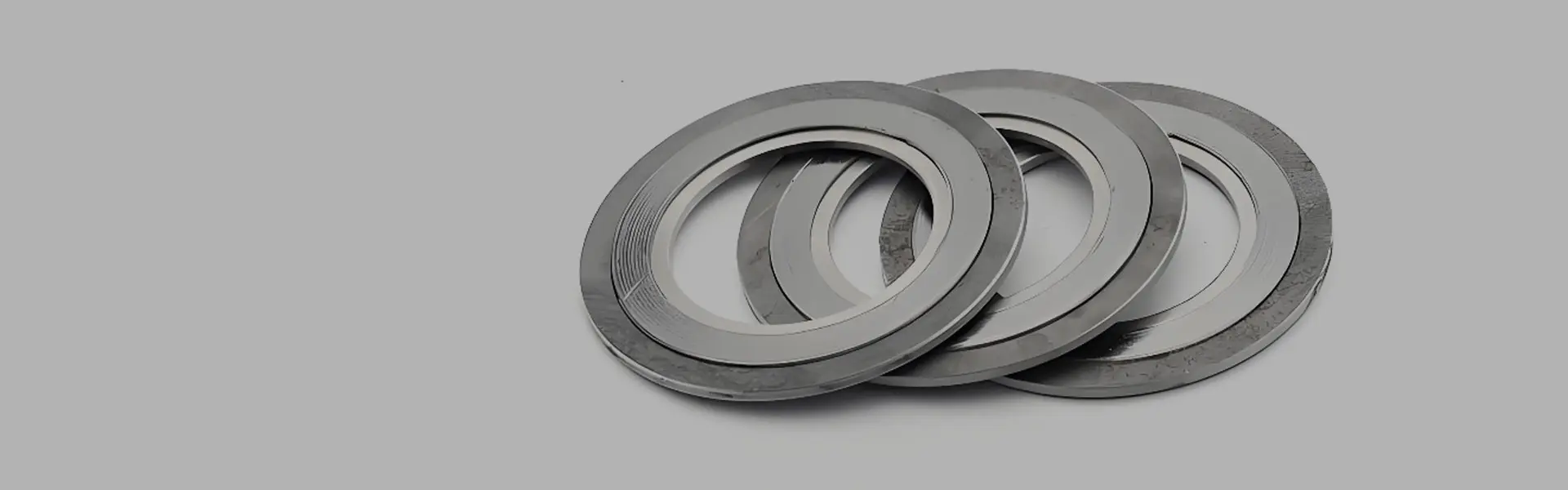
For over two decades, Kaxite has been at the forefront of engineering and manufacturing premium sealing solutions. Among our most critical and widely specified products are Spiral Wound Gaskets. These are not just gaskets; they are meticulously engineered components designed to create absolute, leak-proof seals in the most demanding high-pressure and high-temperature environments found across global industries. Their unique construction offers unparalleled flexibility, resilience, and recovery, making them the go-to choice for flange connections in pipelines, pressure vessels, heat exchangers, and valve systems where safety and integrity are non-negotiable.
The superior performance of a spiral wound gasket lies in its innovative layered structure. At Kaxite, we masterfully combine alternating plies of a pre-formed metal winding strip and a soft, conformable filler material. This combination is wound concentrically under precise, computer-controlled tension to form a robust, V-shaped spiral cross-section.
This dual-material system allows the gasket to compensate for flange misalignment, thermal cycling, and vibration, maintaining a consistent seal throughout its service life.
Selecting the correct Spiral Wound Gaskets involves understanding key parameters. Kaxite offers extensive customization to meet exact operational requirements.
Kaxite spiral wound gaskets are manufactured to fit all standard and custom flange dimensions.
| Flange Standard | Size Range (Nominal Pipe Size) | Pressure Class (ANSI/ASME) | Pressure Class (DIN) |
|---|---|---|---|
| ANSI/ASME B16.20, B16.5 | ½" to 60" | 150, 300, 600, 900, 1500, 2500 | - |
| DIN EN 1092-1, DIN 2696 | DN 10 to DN 1200 | - | PN 6, 10, 16, 25, 40, 64, 100, 160, 250, 320, 400 |
| API 6A (Wellhead) | Various | API 5,000 psi to 20,000 psi | - |
The selection of metal winding and filler material is critical for compatibility with the process media, temperature, and pressure.
| Metal Windings (Common Grades) | Typical Temperature Range | Common Filler Materials | Primary Application/Resistance |
|---|---|---|---|
| 304/304L Stainless Steel | -250°C to 540°C | Flexible Graphite, PTFE, Ceramic, Mica | General purpose, steam, water, mild chemicals. |
| 316/316L Stainless Steel | -250°C to 540°C | Flexible Graphite, PTFE | Enhanced corrosion resistance (acids, chlorides). |
| Alloy 20 | -45°C to 540°C | Flexible Graphite, PTFE | Severe corrosive services (sulfuric acid, phosphoric acid). |
| Monel 400 | -240°C to 820°C | Flexible Graphite | Marine, hydrofluoric acid, caustic solutions. |
| Inconel 600/625 | -200°C to 1095°C | Flexible Graphite, Ceramic | High-temperature oxidising environments, furnaces. |
| Titanium | -250°C to 540°C | Flexible Graphite | Chloride and seawater applications. |
Q: What are the primary advantages of using a spiral wound gasket over other gasket types?
A: Spiral wound gaskets offer several key advantages: Superior Resilience: Their "spring-back" characteristic compensates for thermal cycling and vibration, maintaining seal integrity. Wide Application Range: Able to handle extreme pressures (from vacuum to over 25,000 psi) and temperatures (cryogenic to over 1000°C). Robustness: More forgiving of flange surface conditions and minor misalignments compared to solid metal gaskets. Customization: Material combinations can be tailored for specific chemical, pressure, and temperature requirements. Reliability: Proven long-term performance in critical service, reducing downtime and maintenance costs.
Q: How do I select the correct metal and filler material for my application?
A: Selection is based on the "M-O-P" criteria: Media (Chemical Compatibility): The filler and metal must resist corrosion from the process fluid. Consult chemical resistance charts. Operating Temperature: Both materials must maintain integrity and sealing force at min/max temperatures. Graphite oxidizes above 450°C in air, requiring special grades or alternative fillers. Pressure: Higher pressures require stronger metals (like 316SS or higher alloys) and potentially an inner ring (Style CGI) to prevent blow-out. Always reference ASME B16.20 or DIN EN 1514 standards and consult with Kaxite engineers for critical applications.
Q: Can Kaxite spiral wound gaskets be used for both raised face and flat face flanges?
A: They are primarily designed for use between Raised Face (RF) flanges. The gasket sits concentrically on the raised face, with the outer ring (if present) helping with centering. For Flat Face (FF) flanges, a full-face gasket type is typically recommended to distribute load across the entire flange surface and prevent bending. Using a standard spiral wound gasket on FF flanges can lead to over-stressing the flange and seal failure. Kaxite offers specific recommendations based on your flange type.
Q: What is the purpose of the inner ring on a Style CGI gasket?
A: The inner ring serves multiple critical functions: Prevents Gasket Buckling: It acts as a barrier to stop the internal pressure from forcing the soft windings into the pipeline, which could cause erosion, turbulence, and eventual seal failure. Protection: Shields the vulnerable inner edge of the windings from corrosive flow or erosion. Heat Resistance: In high-temperature services, it helps dissipate heat from the windings. Guidance: Aids in proper radial positioning of the gasket. It is essential for high-pressure, high-flow, or thermal cycling applications.
Q: How important is proper bolt torque and tightening sequence during installation?
A: It is absolutely critical. An unevenly loaded flange will not achieve a uniform seal. Always follow a cross-pattern tightening sequence (e.g., star pattern) in multiple passes (typically 3-4), gradually increasing the torque to the final specified value. The final target torque should be calculated based on the bolt size, grade, gasket style, and service conditions—often referenced in standards like ASME PCC-1. Under-torquing can cause leakage; over-torquing can crush the gasket, damaging its resilient properties or even damaging the flange. Kaxite provides detailed installation guidelines with its products.
Q: Are Kaxite spiral wound gaskets reusable?
A: Generally, spiral wound gaskets are not recommended for reuse. Once compressed during installation, the metal windings and filler material have undergone plastic and elastic deformation specific to that flange set and bolt load. Reusing a gasket risks improper seating, reduced resilience, and a higher probability of leakage. For critical systems, always install a new, certified Kaxite gasket during any maintenance procedure to ensure optimal seal integrity and safety.
Q: How does Kaxite ensure the quality and traceability of its gaskets?
A: At Kaxite, quality is embedded in our manufacturing process. We adhere to stringent international standards (ISO 9001, ASME, API, PED). Each batch of raw material is certified. Our CNC winding machines ensure precise, consistent density. Every gasket is visually and dimensionally inspected. For critical orders, we provide full Material Test Certificates (MTCs/CofCs) traceable to a unique heat/lot number, detailing the chemical and mechanical properties of the metals and fillers used. This guarantees you receive a product that meets exact specifications for performance and compliance.
The versatility of Kaxite spiral wound gaskets makes them indispensable in numerous sectors:


Copyright © 2015-2025 Ningbo Kaxite Sealing Materials Co., Ltd. All Rights Reserved.


