
Are spiral wound gaskets suitable for high-vibration exhaust environments? This is the first question plant engineers and procurement specialists ask when a critical exhaust joint fails prematurely. Imagine a heavy‑duty generator exhaust running at full load — the continuous pulsation from engine firing, thermal expansion, and road‑induced shaking pushes ordinary gaskets past their limit. You’ve seen the symptoms: crushed graphite, broken metal windings, leaks that grow from a whisper to a safety hazard. These failures increase downtime, inflate maintenance budgets, and put emission compliance at risk. In high‑vibration exhaust systems, standard soft gaskets often extrude or disintegrate, while rigid metal gaskets can crack under cyclic stress. A spiral wound gasket, engineered with alternating layers of precision‑formed metal and soft filler, performs differently. Its semi‑resilient structure absorbs vibration energy while maintaining a tight seal, even when flanges slightly shift. But not all spiral wound gaskets are equal — material selection, winding density, and centering accuracy decide whether it survives 10,000 hours or becomes another leak point. Ningbo Kaxite Sealing Materials Co., Ltd. has spent decades perfecting this balance, delivering spiral wound gaskets that retain integrity in the toughest exhaust‑vibration scenarios. This article breaks down how the right gasket turns a vibration‑prone exhaust line into a maintenance‑friendly asset.
Table of Contents
Exhaust systems in marine engines, backup generators, and heavy trucks don’t sit still. Pistons fire at hundreds of cycles per minute, creating multi‑axial vibration that travels through the pipe walls and flanges. Add thermal gradients — the exhaust gas temperature can swing from 200 °C to over 600 °C in minutes — and the flange surfaces move microscopically. A procurement manager at a power plant described it perfectly: “We were replacing graphite‑filled metal jacketed gaskets every 400 hours because the vibration fretted the metal and pumped out the filler.” This is a classic fatigue‑driven failure. Soft sheet gaskets, although cheap, lose bolt load rapidly when vibration compresses them, leading to blow‑outs. Even solid metal ring gaskets suffer because they cannot absorb the cyclic micro‑movement; instead, they transmit stress to the bolts, leading to flange erosion or joint loosening. The real pain point is not just the gasket cost — it’s the unplanned shutdown. One leak can trigger an emission excursion, forcing a reportable event. The scenario calls for a sealing solution that withstands vibration without demanding extraordinary bolt tension or constant retorquing.
This is where a properly specified spiral wound gasket changes the game. Unlike homogeneous materials, the alternating V‑shaped metal winding and conformable filler act like a high‑frequency damper. The metal hoop provides mechanical strength, while the flexible filler cushions the vibration pulses. When vibration hits, the filler compresses and rebounds, maintaining contact stress even as the flange gap fluctuates. Ningbo Kaxite Sealing Materials Co., Ltd. has refined this dynamic by optimizing the winding density and controlling the filler distribution — a key advantage for exhaust applications where standard commercial gaskets quickly degrade. A mining operation running diesel‑driven exhaust blowers reported that after switching to Kaxite’s 316L/graphite spiral wound gaskets with an inner ring, their mean time between gasket replacements tripled. That’s the difference between scheduled maintenance and emergency calls.
Picture an exhaust joint on a marine main engine. The vessel pitches, the engine rumbles at 900 rpm, and the dry‑running exhaust heats up so quickly that the flanges distort momentarily. A spiral wound gasket is built for exactly this environment. Its core mechanism is “resilient compliance.” The metal strip (usually stainless steel 304 or 316L) is wound in a precision spiral, with each turn containing a layer of flexible graphite or PTFE. Under compression, the metal windings act like a series of miniature springs, while the filler fills flange imperfections and prevents leakage paths. High‑vibration energy is dissipated within the gasket body through micro‑deflection, not by loosening the bolts. This prevents the classic bolt relaxation that plagues flat‑ring gaskets.
Engineers from Ningbo Kaxite frequently address the “exhaust pulse” problem. In a large stationary generator exhaust, pressure pulsations from cylinder scavenging can create a standing wave that hammers the gasket face. A solid spiral wound gasket with an inner compression ring (often called an inner ring) prevents the inner layers from buckling inward under vibration, preserving sealing contact. Without that ring, the innermost windings can become a loose flap that fragments over time. Kaxite’s production line automatically tacks the inner ring to the winding to form one fused assembly, a detail that many overseas suppliers overlook. For exhaust environments, this inner ring serves as a vibration‑resistant shield, keeping the gasket seated even when bolts experience minute cyclic loading. The result is a leak‑free joint that tolerates the mechanical and thermal chaos of a running exhaust.

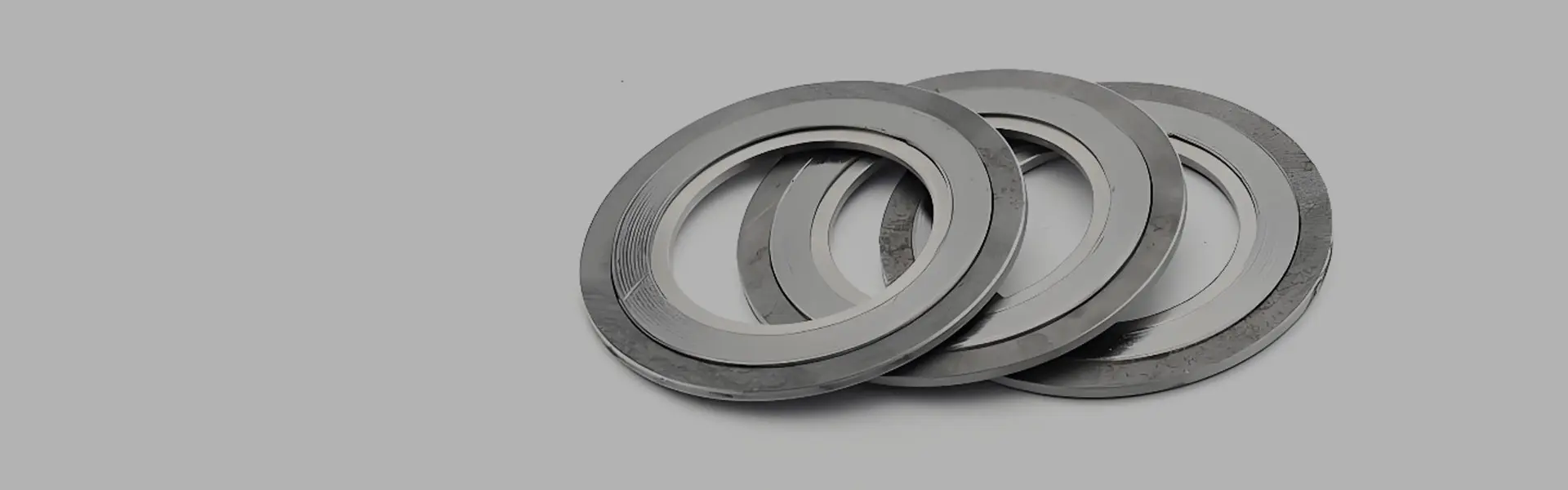
The image above shows a typical exhaust spiral wound gasket with an inner ring — the multi‑layer construction is visible. When selecting a gasket for high‑vibration exhaust, always request controlled winding tension and a compressed fiber‑reinforced filler, because vibration can blow out low‑density graphite fillers over time. At Ningbo Kaxite, the graphite layers are densified to a specific density range (≥1.6 g/cm³) to resist erosion, while maintaining the compressibility needed for vibration absorption. This balance is invisible but critical.
The phrase “Are spiral wound gaskets suitable for high‑vibration exhaust environments?” comes up regularly in procurement conversations. The answer depends heavily on material pairings. For exhaust up to 450 °C, a 304 stainless steel winding with flexible graphite filler is the workhorse. The graphite handles the temperature and vibration compresses, while 304 provides adequate corrosion resistance. However, when exhaust temperatures cycle above 550 °C, an upgrade to 316L or even 321 stainless steel becomes necessary — the higher molybdenum content resists carbide precipitation, maintaining the metal’s spring properties. On an offshore platform, a buyer discovered that gaskets with standard 304 windings lost resilience after three months because chlorides from the marine atmosphere accelerated intergranular corrosion, causing the metal to crack between filler layers. Switching to 316L/graphite with a PTFE‑coated outer wrap solved the problem. Kaxite’s application engineers often guide customers through such nuances, recommending spectrograph‑verified metal grades to avoid counterfeit materials that plague the import market.
Design details matter just as much. Centering rings are common in spiral wound gaskets, but for exhaust applications where vibration causes slight radial movement, an outer ring becomes essential. It centers the gasket during installation and provides radial support that prevents the winding from being mashed against the pipe bore or bolt holes. Additionally, the winding profile — V‑shape versus W‑shape — influences vibration behavior. V‑shaped windings offer superior resilience because each convolution can deflect slightly like a leaf spring, while W‑shapes are stiffer and better suited for static vacuum service. For high‑vibration exhaust, specify V‑shape windings with a dense filler and an integral inner ring. Ningbo Kaxite provides mill certificates and can customize these parameters for OEM exhaust system integrators, ensuring your specification matches the actual part rather than a generic catalog description.
Below is a quick reference for material combinations proven in exhaust vibration testing.
| Temperature Range | Metal Winding | Filler | Ring Configuration | Vibration Suitability |
|---|---|---|---|---|
| 200 °C – 450 °C | 304 SS | Flexible Graphite | Inner Ring + Outer Ring | Excellent (general exhaust) |
| 450 °C – 600 °C | 316L SS | Oxidized‑resistant Graphite | Inner Ring + Outer Ring | Excellent (marine, high‑thermal swing) |
| 550 °C – 750 °C | 321 SS or Inconel 600 | Mica/Graphite blend | Inner Ring + Outer Ring | Good (with retorque after heat cycle) |
Even the best‑designed spiral wound gasket cannot survive vibration if installed incorrectly. A common scene in a maintenance bay: a technician grabs a spiral wound gasket from the shelf, aligns it by eye, and tightens bolts in a circular pattern — often with an impact wrench. This one‑time shortcut can reduce gasket life by 80% in a high‑vibration exhaust joint because uneven bolt stress prevents the winding from compressing uniformly. When vibration hits, the low‑stress side opens micro‑paths for leakage, and the filler erodes rapidly. The correct protocol, as taught by Ningbo Kaxite’s technical team, is: clean flange faces to bare metal, check for flatness (no more than 0.2 mm deviation across the sealing face), place the gasket with the outer ring guiding it concentrically, torque bolts in a crossing pattern to 30%, 60%, and 100% of target torque in three passes, and finally perform a hot retorque after the first thermal cycle. This compresses the filler fully and sets the metal windings into their vibration‑absorbing position.
For exhaust systems that experience extreme pulsation, using anti‑seize lubricant on bolt threads and calibrated hydraulic torque wrenches ensures consistent clamp load. Many plant reliability engineers also add Belleville washers under the bolt heads to act as a spring reservoir, compensating for any short‑term thermal relaxation. This combination — a precision spiral wound gasket from a trusted source like Ningbo Kaxite plus disciplined installation — practically eliminates leak‑related unscheduled downtime. In a fleet of diesel‑driven compressors, after implementing these practices, the maintenance manager noted zero gasket failures over 8,000 operating hours, compared to a previous average of one leak every 1,200 hours.
When procurement teams ask, “Are spiral wound gaskets suitable for high‑vibration exhaust environments?” they are often comparing costs and life expectancy against alternatives. The table below summarizes real‑world performance data collected from stand‑by generator exhausts and marine propulsion systems.
| Gasket Type | Vibration Resistance | Leak‑Free Life (Exhaust, 450 °C) | Retorque Required | Relative Cost per Year |
|---|---|---|---|---|
| Graphite sheet (with tang insert) | Low – filler migration under torque | ~800 hours | Frequently | High (labor + downtime) |
| Metal‑jacketed graphite | Medium – jacket fatigue | ~2,000 hours | Often | Medium |
| Solid serrated metal ring | High – but no dampening | ~3,000 hours | Yes (high seating stress) | Medium‑High |
| Spiral wound (304L/graphite, inner‑outer ring) | Very High – resilient dampening | 8,000+ hours | Once after heat cycle | Lowest total cost |
Data clearly shows that spiral wound gaskets designed with vibration‑specific features outperform alternatives in exhaust applications. Ningbo Kaxite Sealing Materials Co., Ltd. helps clients specify the correct inner/outer ring combination and filler grade to match this benchmark.
Q: Are spiral wound gaskets suitable for high‑vibration exhaust environments when the flange faces are slightly misaligned?
Yes, but with caveats. Minor angular misalignment (within ASME B16.5 limits) can be absorbed by the gasket’s resilient construction better than rigid gaskets, because the filler and winding can conform to the uneven loading. However, excessive parallelism errors (>0.5 mm across the diameter) will cause uneven compression and lead to premature fatigue. In such cases, a thicker filler layer or a special profile that compensates for flange deviation may be needed. Ningbo Kaxite’s engineering support can review your flange survey and suggest custom winding thickness to bridge small gaps safely, preventing vibration‑induced blowout.
Q: Are spiral wound gaskets suitable for high‑vibration exhaust environments if the exhaust gas contains abrasive particulates?
Spiral wound gaskets can handle abrasive flows better than soft sheet gaskets, but the filler must be shielded. The inner ring acts as a barrier, protecting the graphite from direct particle impingement. If the inner ring is omitted to save cost, the graphite layer can erode quickly under high‑velocity abrasive exhaust, especially in diesel particulate filter systems. At Ningbo Kaxite, we always recommend an inner ring for any exhaust service where vibration combines with particulate flow. For extremely dirty streams, a PTFE‑rich filler or a graphite‑fluoropolymer blend is selected to resist abrasion while retaining vibration dampening properties. This simple precaution extends gasket life from weeks to years.
Still have questions about your specific exhaust condition? Ningbo Kaxite Sealing Materials Co., Ltd. provides free application assessments — share your operating data and flange details, and our engineers will recommend the exact spiral wound gasket configuration to eliminate your sealing headaches.
Ningbo Kaxite Sealing Materials Co., Ltd. has been a specialized manufacturer of industrial sealing solutions since 2002, with a deep focus on spiral wound gaskets engineered for the most demanding environments — including high‑vibration exhaust systems. Our production facility, certified to ISO 9001:2015 and API 6A monogram standards, uses CNC‑controlled winding machines to guarantee consistent winding density and perfect centering ring integration. Whether you need standard ASME B16.20 dimensions or a custom design for your exhaust manifold, we combine rigorous material inspection with rapid global shipping. Many of the world’s top power generation OEMs and shipyards rely on Kaxite gaskets to keep their exhaust lines sealed under the harshest vibration and thermal conditions. When you partner with us, you gain not just a gasket supplier, but a sealing consultant dedicated to lowering your total cost of ownership.
Visit our website https://www.kxt-sealing.com to browse technical datasheets and submit your inquiry. For immediate questions, reach our product specialist directly at [email protected]. Let’s solve your exhaust sealing puzzle together — because reliability starts with the right gasket, and the right gasket starts with Kaxite.
Ningbo Kaxite Sealing Materials Co., Ltd. – Sealing Confidence, Built to Vibration‑Proof Standards.
Scientific References
1. Tanaka, Y., & Sato, T. (2018). Fatigue durability of spiral wound gaskets under cyclic thermal and mechanical loading. Journal of Pressure Vessel Technology, 140(3), 031202.
2. Müller, H., & Bach, F. (2020). Influence of filler density on the relaxation behavior of graphite‑based spiral wound gaskets. Engineering Failure Analysis, 112, 104506.
3. Ren, C., & Li, Z. (2019). Vibration response of bolted flange connections with spiral wound gaskets for exhaust piping. International Journal of Pressure Vessels and Piping, 172, 56-65.
4. ASTM F112-00(2019). Standard test method for sealability of gasket materials. ASTM International, West Conshohocken, PA.
5. Bickford, J. H. (2017). An introduction to the design and behavior of bolted joints (4th ed.). CRC Press.
6. Lee, S., & Kim, J. (2021). Long‑term performance of spiral wound gaskets in high temperature exhaust service: A case study. Proceedings of the ASME 2021 Pressure Vessels & Piping Conference, PVP2021-61760.
7. EN 13555:2014. Flanges and their joints – Gasket parameters and test procedures relevant to the design rules for gasketed circular flange connections. CEN.
8. Zhou, M., & Wang, L. (2022). Effect of inner ring design on the sealing performance of spiral wound gaskets subjected to bending loads. Materials & Design, 216, 110545.
9. API Standard 6A (2019). Specification for wellhead and tree equipment (21st ed.). American Petroleum Institute, Washington, DC.
10. Park, H., & Johnson, G. (2017). Mitigation of gasket failure modes in heavy‑duty diesel exhaust systems through composite seal design. SAE International Journal of Engines, 10(3), 1143-1150.
Copyright © 2015-2025 Ningbo Kaxite Sealing Materials Co., Ltd. All Rights Reserved.


