
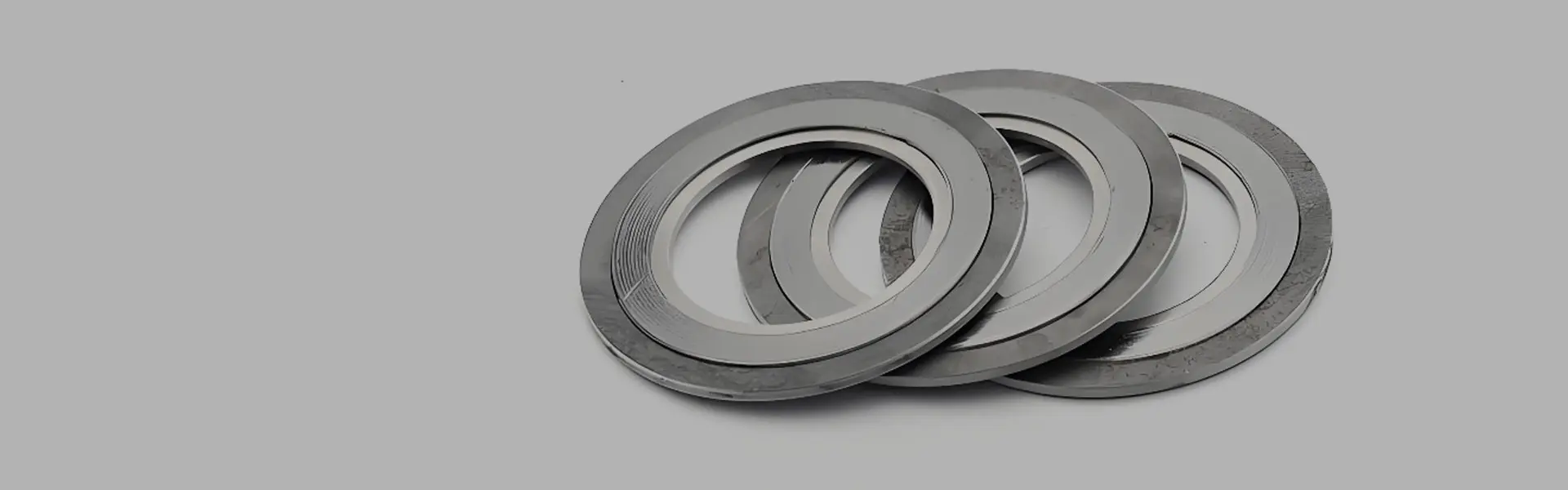
In the demanding world of industrial sealing, where pressure, temperature, and chemical resistance are non-negotiable, Corrugated Gaskets stand out as a premier choice for engineers and maintenance professionals. These gaskets are engineered to provide a robust, reliable seal in the most challenging environments, from oil and gas refineries and chemical processing plants to power generation facilities. Their unique design combines flexibility with structural integrity, allowing them to conform to flange surfaces while maintaining a tight seal under varying operational conditions. At Kaxite, we specialize in the design and manufacture of high-quality corrugated gaskets, utilizing advanced materials and precision engineering to meet the exacting standards of global industries.
The core principle behind a corrugated gasket's effectiveness lies in its construction. The distinctive corrugated, or serrated, metal core provides a spring-like action. This allows the gasket to compensate for thermal expansion, contraction, and flange rotation, maintaining sealing force throughout the operational cycle. This characteristic is crucial for preventing leaks in systems experiencing thermal cycling or pressure fluctuations. Kaxite's expertise ensures that each gasket is optimized for its intended application, whether it requires exceptional creep resistance, high-temperature stability, or compatibility with aggressive media.
Selecting the correct corrugated gasket requires a detailed understanding of its parameters. Kaxite provides comprehensive specifications to ensure perfect alignment with your system requirements. Our gaskets are defined by several critical attributes.
| Parameter | Typical Range / Options | Kaxite Standard | Notes |
|---|---|---|---|
| Size Range (Inner Diameter) | 15 mm (1/2") to 3000 mm (120") and above | Full range available, custom sizes on request | Larger sizes may be segmented for handling. |
| Pressure Rating | Up to 300 Bar (≈ 4350 PSI) | Designed per ASME B16.20 / EN 1514-2 | Rating depends on core material thickness and facing. |
| Temperature Range | -200°C to +1000°C (-328°F to +1832°F) | Material dependent. Graphite faces up to 550°C in oxidizing air. | Inert/in reducing atmospheres, graphite can exceed 3000°C. |
| Core Thickness | 0.2 mm to 0.5 mm (Standard) | 0.25 mm and 0.4 mm are most common. | Thicker cores for higher pressure/load. |
| Facing Thickness (per side) | 0.5 mm to 1.5 mm | 0.75 mm standard for graphite. | Thicker facing for better conformability on rough flanges. |
| Gasket Density (Graphite Faced) | 1.0 - 1.3 g/cm³ | 1.1 g/cm³ (controlled for consistency) | Ensures uniform sealing performance. |
| Standards Compliance | ASME B16.20, EN 1514-2, API 601, DIN, JIS | All major international standards | Material traceability and certifications provided. |
| Application Environment | Recommended Metal Core | Recommended Facing Material | Key Benefit |
|---|---|---|---|
| General Petrochemical Service, Steam | 304 or 316 Stainless Steel | Expanded Graphite | Excellent balance of cost, temperature, and chemical resistance. |
| Highly Corrosive Acids (e.g., Sulfuric, HCl) | Hastelloy C276 / Monel 400 | PTFE or Expanded Graphite* | Maximum corrosion resistance of core and facing. |
| High-Temperature Heat Exchangers, Exhausts | Inconel 625 | Expanded Graphite or Ceramic Fiber | Retains strength and seal at extreme temperatures. |
| Chloride / Offshore / Seawater Service | Titanium or 316L SS | Expanded Graphite | Superior resistance to pitting and stress corrosion cracking. |
| Food, Pharmaceutical, Ultra-Pure Media | 316L Stainless Steel (Electropolished) | PTFE (FDA compliant grades) | Non-contaminating, easy cleanability, broad chemical inertness. |
Q: What are the main advantages of using a corrugated metal gasket over a standard flat gasket?
A: Corrugated gaskets offer several distinct advantages. Their spring-like metal core provides superior resilience and recovery, meaning they can maintain a tight seal during thermal cycling and pressure changes where flat gaskets might relax and leak. They require lower bolt load to achieve an initial seal compared to solid metal gaskets, reducing stress on flanges. The corrugated design also allows for better conformity to minor flange imperfections. Furthermore, they are highly resistant to blow-out under high internal pressure or vacuum conditions.
Q: How do I select the right metal core material for my application?
A: The selection is primarily driven by the chemical compatibility and temperature of the process fluid. For most common applications with steam, oils, and mild chemicals, 304 or 316 stainless steel is sufficient. For highly corrosive environments (e.g., sulfuric acid, chlorides), alloys like Monel, Hastelloy, or Titanium are necessary. For extreme temperatures (above 800°F/427°C), high-nickel alloys like Inconel are required. Always consult the corrosion charts for your specific media and consider factors like pH, concentration, and temperature. Kaxite engineers can provide detailed material selection support.
Q: Can corrugated gaskets be used on raised face (RF) and flat face (FF) flanges?
A: Yes, but with important considerations. Corrugated gaskets are most commonly and effectively used on raised face (RF) flanges. The raised face provides a defined sealing area that concentrates the bolt load, allowing the corrugations to bite and seal optimally. For flat face (FF) flanges, a full-face corrugated gasket (which covers the entire flange surface, including bolt holes) is typically required to distribute the load properly and prevent over-stressing the flange. Using a ring-type gasket on a flat face flange is not recommended as it can lead to flange bending.
Q: What is the purpose of the soft facing material (like graphite or PTFE) on the gasket?
A: The soft facing material serves multiple critical functions. First, it provides initial sealability at relatively low bolt loads by easily conforming to micro-irregularities on the flange surface. Second, it acts as a gas-tight barrier, filling the grooves of the metal corrugations. Third, it protects the metal core from direct corrosion by the process media. Finally, materials like graphite have excellent thermal stability and maintain their sealing properties across a wide temperature range.
Q: How do I determine the correct bolt torque for installing a Kaxite corrugated gasket?
A: The correct bolt torque is crucial and is not a generic value. It depends on the gasket size, material combination (core and facing), flange rating (Class 150, 300, etc.), and bolt material. Over-torquing can crush the gasket, damaging the facing and metal core, while under-torquing will not activate the gasket's sealing capability. Kaxite provides detailed installation guidelines and recommended bolt loads (in N/mm or lb/in of gasket perimeter) with each product series. Always follow a star-pattern, cross-bolting sequence and perform multiple pass torquing to achieve an even load distribution.
Q: Are Kaxite corrugated gaskets reusable?
A: Generally, corrugated gaskets are considered non-reusable. Once compressed during installation, the metal core undergoes plastic deformation and the facing material compresses to form a seal specific to that flange set. Reusing a gasket from a previous assembly risks a leak because the gasket has already taken a "set" and may not properly conform to the flange surfaces again. Additionally, the facing material may be damaged upon removal. For reliability and safety, Kaxite always recommends using a new gasket for each flange assembly.
Q: How does Kaxite ensure the quality and traceability of its gaskets?
A: Kaxite implements a rigorous quality management system. We use certified raw materials with full Mill Test Reports (MTRs) for traceability. Our manufacturing process involves precision laser cutting or stamping, controlled corrugation forming, and specialized bonding techniques for the facing. Every production batch undergoes dimensional checks, visual inspections, and may be subject to performance tests like leak rate or density checks. Certificates of Conformance (CoC) are supplied with shipments, detailing the material grades, heat numbers, dimensions, and the standard to which they were manufactured.
Beyond our standard catalog offerings, Kaxite prides itself on providing engineered sealing solutions. Our technical team works directly with clients to analyze specific application challenges, such as extreme temperature gradients, severe cyclic loading, or unique chemical exposures. We can design custom corrugated gaskets with variations in corrugation pitch, depth, and pattern to optimize sealing force and resilience. We also offer gaskets with special coatings, combined materials (like dual-facing with graphite on one side and PTFE on the other), and integrated sensor ports for monitoring purposes. Partnering with Kaxite means accessing deep technical expertise to enhance the reliability, safety, and efficiency of your operations.

Copyright © 2015-2025 Ningbo Kaxite Sealing Materials Co., Ltd. All Rights Reserved.


